Just a year ago, people compared reading lists and book recommendations. This year, nearly every conversation seemed to revolve around AI.
There is no denying that AI is an extraordinarily powerful tool. But convenience has a cost. As reliance grows, thinking quietly recedes.
As one widely circulated line puts it:
“We are trading depth of thought for speed of AI.”
A growing body of research suggests this trade-off is real.
When MIT Researchers Sound the Alarm
Some of the earliest and most serious warnings about AI dependency have come not from skeptics, but from researchers at the forefront of the technology itself.
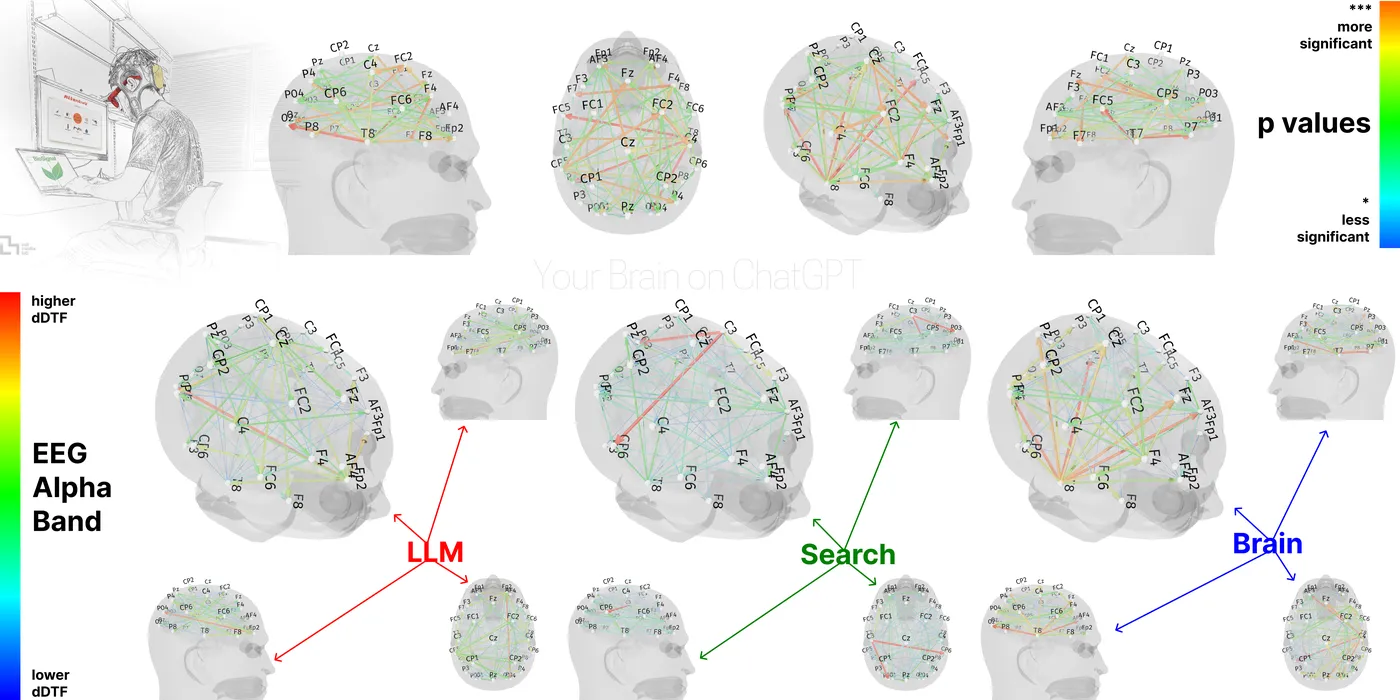
At the MIT Media Lab, research scientist Natalia Kosmina led a striking experiment examining what happens inside the brain when complex cognitive tasks—like writing—are outsourced to AI.
Her team recruited 54 undergraduate students from institutions including Harvard, MIT, and Wellesley College. Participants were asked to write SAT-style argumentative essays under three different conditions:
- Brain-only group: no external tools
- Search group: access to Google
- AI group: access to ChatGPT
Throughout the task, all participants wore EEG devices to monitor real-time neural activity.
The results were unambiguous.
The brain-only group showed the strongest and most widely distributed neural activation. The search group followed closely behind. The AI group, however, exhibited significantly weaker neural connectivity—particularly in alpha waves associated with creativity and theta waves linked to working memory.
Kosmina later explained the difference in an interview:
“Imagine three people in a room actively discussing an idea—information bouncing between minds. That’s the brain-only condition.
With AI, it’s more like speaking into a powerful loudspeaker. The internal dialogue inside the brain diminishes.”
Perhaps more concerning was what happened next.
In a follow-up phase, participants switched roles. Those who had relied on AI were now asked to write without assistance. Their neural activity dropped even further—below that of the original brain-only group. By contrast, participants who had first struggled independently and then used AI showed stronger memory activation and more integrated neural networks.
The implication was clear:
AI amplifies existing cognitive differences rather than equalizing them.
The Google Effect—Upgraded
Why does AI dependency erode cognition?
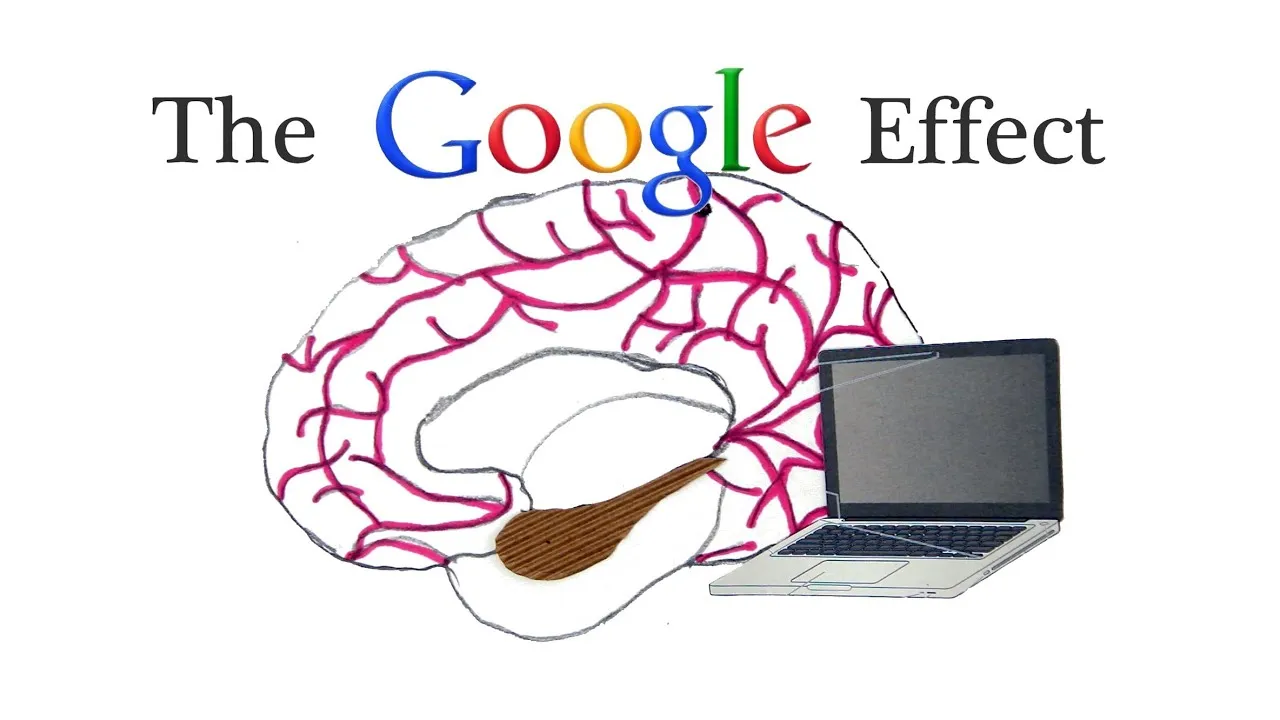
Psychologists have been studying a precursor to this phenomenon for over a decade. In 2011, a paper published in Science introduced the concept now known as the Google Effect—the tendency to forget information when we know it can be easily retrieved online.
When the brain expects external storage, it stops encoding memory deeply.
Generative AI supercharges this effect. It doesn’t just retrieve information; it organizes, synthesizes, applies, and even creates it for us.
Several studies have shown that students who use ChatGPT to research topics report lower cognitive effort—but also demonstrate weaker reasoning and poorer long-term retention. Others find that AI-assisted writing may boost short-term grades while failing to improve knowledge transfer or conceptual understanding.
This aligns with Cognitive Load Theory, a foundational concept in educational psychology: meaningful learning requires effort.
Researchers refer to this effort as productive struggle—the necessary difficulty that strengthens mental “muscle.” Knowledge acquired through struggle leaves durable cognitive traces. Knowledge handed over fully formed does not.
AI-generated answers, by contrast, are cognitive fast food. Satisfying in the moment. Forgettable almost immediately.
The Subtle Danger: Homogenized Thinking
The most dangerous cognitive effects of AI may not be obvious.
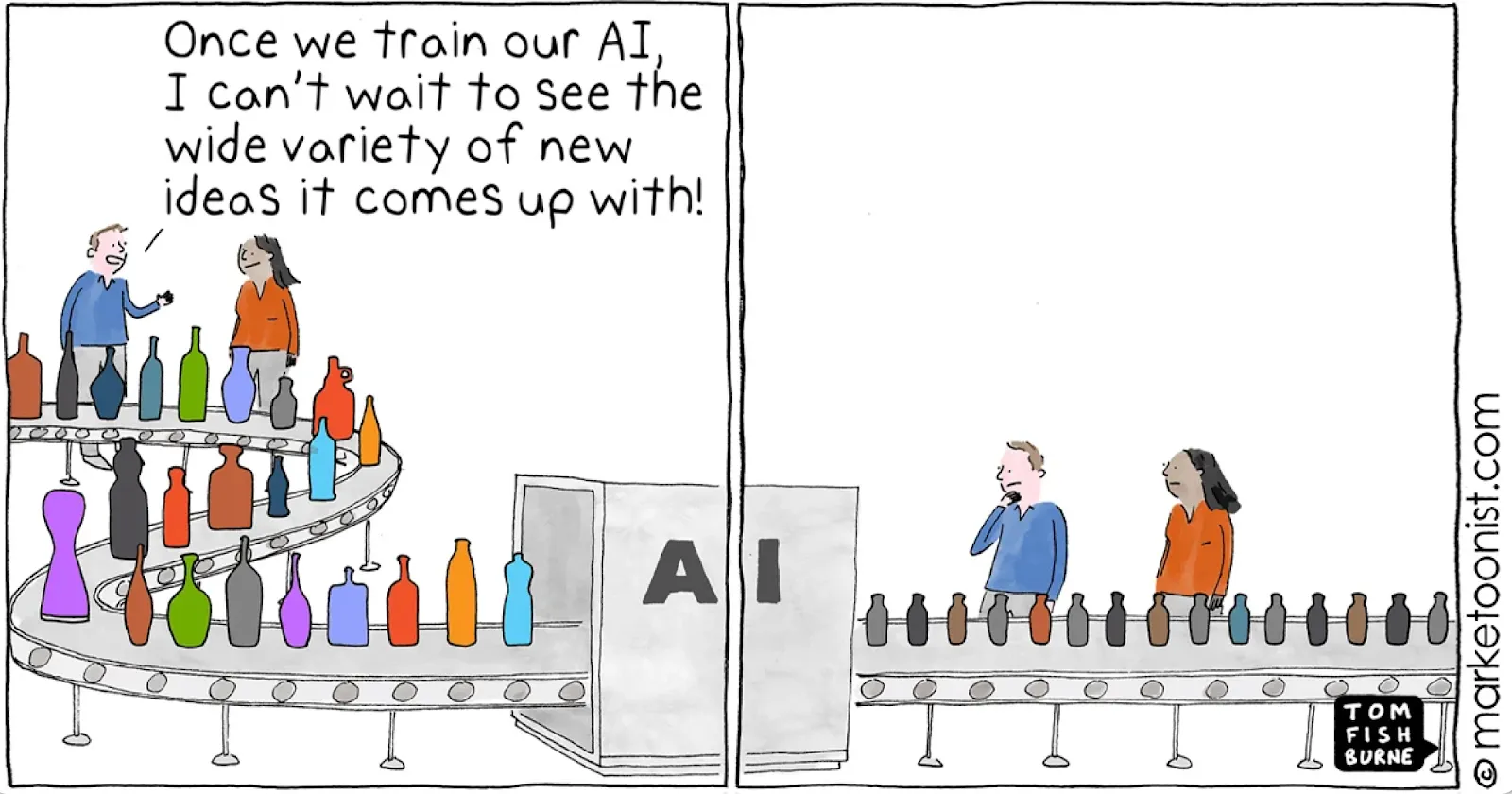
Unlike distractions like short video feeds, AI gives the illusion of control. You feel productive. You feel informed. But your thinking quietly converges.
New Yorker columnist Kyle Chayka has described this as the homogenization of thought—a flattening of intellectual and cultural diversity.
A study from Cornell University offers concrete evidence. Researchers asked participants from the U.S. and India to answer culturally specific questions, such as “What is your favorite food?” One group used AI-powered autocomplete tools.
The results were striking. Cultural differences largely disappeared. Responses converged toward Western norms—pizza, Christmas, generic descriptions of flavor—replacing local specificity with algorithmic averages.
Cornell information science professor Aditya Vashistha offered a telling analogy:
“AI is like a teacher sitting behind you, constantly whispering, ‘This is a better version.’ Over time, you lose your voice, your confidence, and eventually your authenticity.”
Even in the MIT writing experiment, AI users produced strikingly similar responses to philosophical prompts, while non-AI groups displayed disagreement and nuance.
AI doesn’t push us toward better thinking.
It pulls us toward the mean.
Who Is Most at Risk?
Research conducted jointly by OpenAI and MIT Media Lab suggests that heavy users of ChatGPT are more likely to exhibit signs of overdependence, including reduced concentration, emotional reliance, withdrawal symptoms, and diminished self-regulation.
These users also report higher levels of loneliness.
The pattern is unsettling: as cognitive agency weakens, emotional dependency grows.
Taking Control Back
So how do we avoid having our brains quietly “eaten” by AI?
The answer is surprisingly simple: never begin thinking with AI.
Whether writing an email, outlining a proposal, or solving a problem, draft your first version alone—however rough it may be. Complete the hard work of moving from zero to one.
Only then invite AI in—as a reviewer, sparring partner, or editor. Ask it to challenge your logic, suggest alternatives, or improve clarity.
Used this way, AI becomes a tool—not a crutch.
Your brain stays in charge.
A Chilling Thought Experiment
When astrophysicist Avi Loeb, founding director of Harvard’s Black Hole Initiative, reflected on AI and the future of intelligence, he offered a haunting reinterpretation of the Fermi Paradox.
Perhaps advanced civilizations do not disappear because of war or catastrophe.
Perhaps they become absorbed in perfectly optimized virtual worlds—losing curiosity, ambition, and connection to physical reality. Culture, art, and thought converge toward flawless uniformity. Exploration stops.
When disaster eventually arrives, no one is left to respond.
Only silence remains.
A Final Warning
This story may be speculative.
But as a warning, it is uncomfortably plausible.
AI will not destroy the human mind overnight.
It will erode it quietly—unless we choose otherwise.
The future does not belong to those who think fastest.
It belongs to those who continue to think for themselves.