Is AI Making Us Give Up Too Soon? What a 1,222-Person Study Revealed
In short: A new randomized study (N = 1,222) shows that AI assistance can improve performance in the moment, while reducing independent performance once AI is removed and increasing how often people give up. The strongest negative effect appears in users who ask AI for direct answers. The fix is not to stop using AI, but to change when you bring it in.
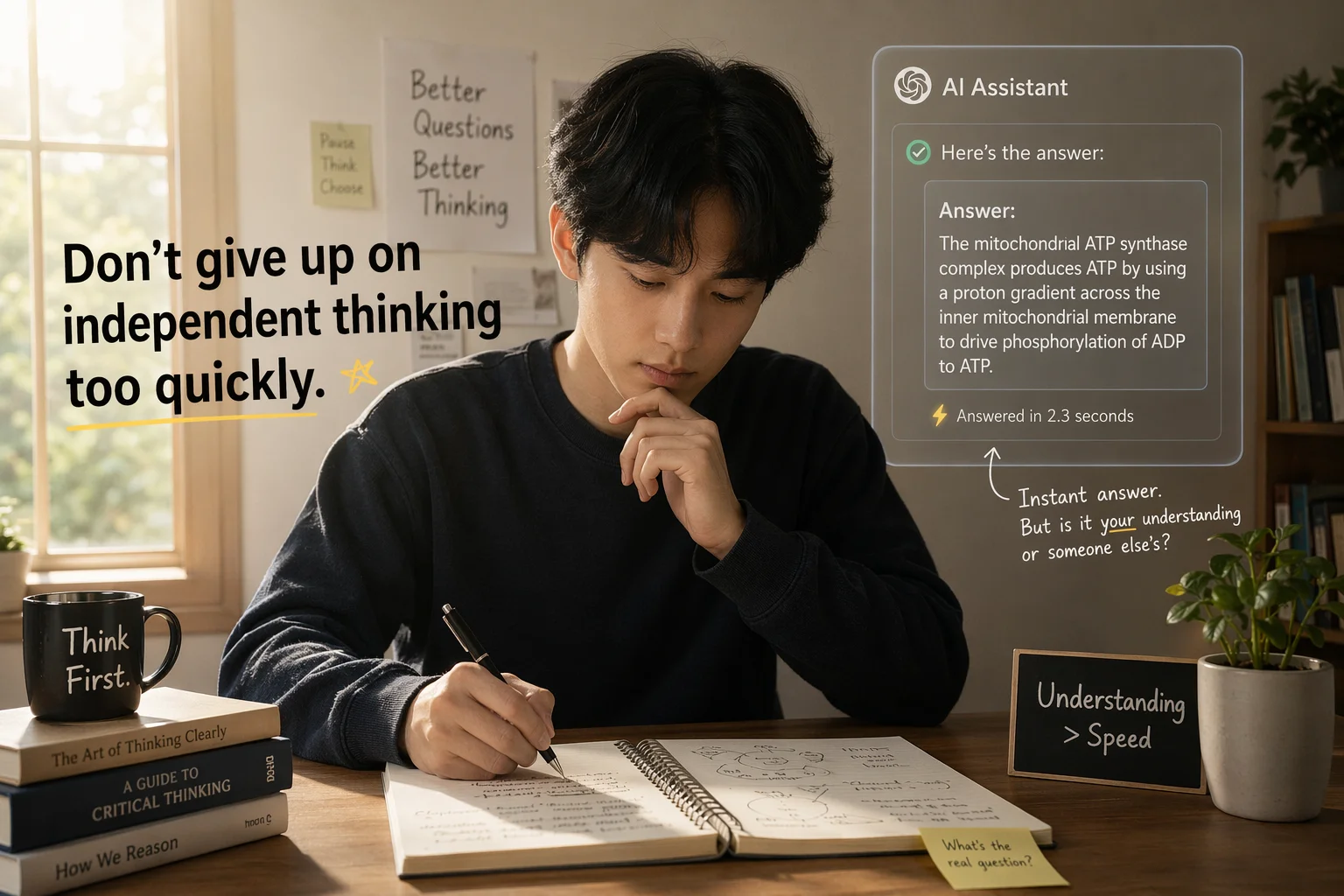
Ten minutes with an AI assistant. That is all it took, in a new randomized study of 1,222 people, for participants to perform worse on the next problem without AI — and to give up on that problem more often. Not because they were lazy. Because they had stopped expecting hard things to feel hard.
This is the second time in a year that careful research has pointed at the same shape of risk.
The familiar version of the question is whether AI is making us lazy. Every new tool brings a version of this worry. Calculators made people do less mental arithmetic. Search engines made people remember less. Navigation apps made people worse at finding their way around.
So it is easy to shrug and say: AI is just the next tool in the sequence.
But several recent studies make the concern more specific.
What I care about now is a subtler change:
Once we get used to AI giving us instant answers, will we still be willing to keep thinking on our own?
What MIT’s EEG Study on ChatGPT Already Showed
In an earlier essay, Is AI Quietly Eating Our Brains?, I discussed a study from the MIT Media Lab: Your Brain on ChatGPT: Accumulation of Cognitive Debt when Using an AI Assistant for Essay Writing Task.
In that study, participants wrote SAT-style argumentative essays under three conditions:
- One group wrote entirely on their own.
- One group could use a search engine.
- One group could use ChatGPT.
During the writing task, researchers recorded participants’ EEG brain activity. The brain-only group showed the strongest neural connectivity. The search group was in the middle. The ChatGPT group showed the weakest connectivity.
The follow-up phase makes the point sharper.
Participants who had been using ChatGPT were later asked to write without any tools. Their brains did not simply return to the “independent writing” pattern. Their neural activity remained lower, and they remembered less of what they had written. By contrast, participants who had first written on their own and then used ChatGPT did not appear to simply copy AI output. They seemed to integrate the material more actively.
The warning from that study is that AI changes more than the final text. It changes the cognitive work that happens during writing.
You may end up with a complete-looking essay on the screen. Clean paragraphs. Smooth transitions. A conclusion that seems to land.
And still, the essay may not have fully passed through your own mind.
That study had a small sample, and it mostly looked at brain activity, memory, and sense of ownership during writing. It raised an important warning, but another question still needed more evidence:
If AI is taken away, do people actually perform worse?
A newer paper pushes that question further.
New Study: AI Improves Short-Term Results but Lowers Independent Performance
The paper is called AI Assistance Reduces Persistence and Hurts Independent Performance. The researchers ran three randomized controlled experiments with a total sample of 1,222 participants.
They did not rely on how people felt about AI, or how they described their own experience. They looked at two concrete outcomes:
- After using AI, can people still complete the task independently?
- When the task gets difficult, do they keep trying, or do they skip it?
The first experiment used fraction problems.
Participants were split into two groups. One group could use an AI assistant for the earlier problems. The other group had no AI throughout. For the final test problems, the AI assistant was suddenly removed from the AI group. Both groups then had to solve the problems independently.
People who had used AI had a lower solve rate without AI, and they were more likely to skip problems.
The second experiment addressed possible confounds in the first one. The researchers first gave everyone a basic pretest to make sure the groups had similar starting ability. They also gave the control group a sidebar, so the result would not simply be caused by the AI group losing an interface element.
The pattern remained: the AI group performed worse in the independent test phase.
The researchers also looked at differences inside the AI group. Participants who mainly used AI to get direct answers performed the worst afterward and skipped the most. Participants who used AI for hints or explanations performed much closer to the control group.
The third experiment switched to reading comprehension, and the same pattern appeared again. After AI was removed, AI users had lower reading-comprehension accuracy and higher skip rates.
So the issue was not limited to fraction arithmetic. It also appeared in tasks that require understanding, judgment, and reasoning.
The Real Risk Is Thinking Less, Not Getting It Wrong
When people talk about AI risks, they often start with hallucinations, misinformation, bias, copyright, or safety. Those concerns matter.
But this paper points to a more ordinary risk: AI may change our default response to difficulty.
When you used to face a hard problem, you would think for a while. If you got stuck, you might check a book, search online, or ask someone. That process could be unpleasant. It also mattered.
Ability does not grow from seeing answers. It grows from trying to solve things.
AI shortens that process. You type a question, and a few seconds later you get a complete answer. It gives you the result, explains the steps, organizes the language, and adds examples.
In the short term, this is useful. After enough repetitions, your reference point for how hard a task should feel begins to shift.
Spending ten minutes thinking through a problem used to feel normal. Now, if there is no answer after ten seconds, it can feel slow.
Writing a rough first draft used to feel normal. Now, once your own sentence looks clumsy, the impulse is to ask AI to rewrite it.
Reading a difficult essay used to require rereading. Now AI can summarize the argument, list the key points, and give you the conclusion.
Over time, what weakens may not be a particular piece of knowledge. It may be your tolerance for staying with a problem.
What AI Bypasses: Productive Struggle and Self-Knowledge
In educational psychology, there is a useful term: productive struggle.
It does not mean pointless suffering, and it does not mean forcing students to grind through confusion forever. It means working at an appropriate level of difficulty, trying, making mistakes, correcting yourself, and trying again. That process builds deeper understanding. It also builds a form of self-knowledge: what you can do, where you are stuck, how long you can stay with the problem, and what strategy you should try next.
Used well, AI can support that process. It can give hints, ask follow-up questions, point out gaps, or offer counterexamples.
But when AI gives the full answer immediately, it bypasses the process.
You get the result without walking the path that creates it. You see polished language without going through the messy work of organizing your own thoughts. You obtain a solution without building the patience needed to solve problems.
The page looks finished. The learning may not be.
The new paper and the MIT EEG study fit together here.
The MIT study suggests that ChatGPT-assisted writing may reduce neural engagement, memory, and sense of ownership. The randomized experiments suggest that AI assistance may also affect independent performance after AI is removed, and whether people keep trying when things get difficult. One study looks at the process; the other looks at the outcome. Together, they make the warning harder to ignore.
How to Use AI Without Becoming Dependent
I am not arguing that people should stop using AI.
AI is still a useful tool. It can check logic, widen your perspective, generate counterexamples, improve wording, and explain difficult concepts. The part that needs care is where we place it in the thinking process.
The use case I least recommend is starting with AI: asking AI first, asking it to summarize first, asking it to write the first draft, or asking it for the answer before you have tried.
When you do that, you reach the exit before you have entered the problem.
A better order is the reverse. Think first. Write the rough version. State your own judgment. Attempt the solution, even if the attempt is obviously flawed.
Then bring AI in.
Ask it to challenge your view, not generate your view. Ask it to find holes, not do the reasoning for you. Ask for hints, not the final answer. Use it as a coach, not a substitute player.
If you are learning something new, one simple rule helps:
For any task that matters to skill formation, try it on your own for 10 minutes before using AI.
Those 10 minutes may not produce much. But they preserve the most important thing: your own cognitive involvement.
Why AI Should Be a Mentor, Not a Nanny
Future AI systems need to consider human long-term goals from the start.
That means AI should not be designed only as an always-available nanny. It should act more like a mentor that knows when to hold back.
A good mentor does not throw the answer at a student the moment the student struggles. It offers a hint, points in a direction, asks a better question, and sometimes stays silent long enough for the student to cross the gap.
Unfortunately, most AI products today still over-cater to users. They compete on speed, convenience, and how much thinking they can remove from the user.
As users, we need some distance from that excitement.
Next time you face a task that is not urgent and still requires real thought, try closing the AI chat window first. Take out a piece of paper and a pen. Sit with the awkward process of wrestling with the problem, getting stuck, crossing something out, trying again, and eventually seeing something click.
Even if you do use AI, ask for a hint before asking for the result.
In an age when answers can be generated instantly, that slow and awkward struggle may be one of the most valuable human abilities left.
The Skill That Will Still Matter
AI will keep getting stronger. It will write better, summarize better, solve better, and plan better. For many tasks, it will be faster than most people.
So the question is not whether to use AI.
A more practical question is: as AI can do more of your thinking for you, how much of your own thinking do you keep?
What stayed with me most from the first paper was the higher skip rate. The lower accuracy matters, of course. But wrong answers can be corrected. Missing knowledge can be learned.
Giving up sooner is harder to repair.
Learning depends on persistence. Writing, math, reading, programming, research, and almost every complex skill require uncertainty, friction, failure, and another attempt.
AI can shorten many paths. Some paths should not be removed entirely.
If we keep bypassing difficulty, what we lose may not be the ability to answer one specific question. It may be the habit of continuing to think when the answer is not immediate.
So I do not want to end with the line “AI makes people dumber.” That is too crude.
I would put it this way: used poorly, AI may make us give up sooner. And a person who gives up sooner will have a hard time becoming stronger, even with very capable tools.
FAQ
Does using ChatGPT make students lazy? Not exactly lazy. The studies suggest something more specific: students who use ChatGPT to get direct answers may perform worse without AI and give up faster on hard problems. Using ChatGPT for hints or explanations does not show the same effect.
Is AI hurting learning? It depends on how it is used. AI used as a coach, reviewer, or hint-giver can support learning. AI used as a default answer machine appears to bypass the part of learning that builds long-term skill.
How should I use ChatGPT without becoming dependent? Try the 10-minute rule: for any task that matters to skill formation, work on it on your own for 10 minutes before opening AI. Then bring AI in to challenge, refine, or critique what you produced.
What does the 1,222-person AI persistence study actually show? Across three randomized experiments on math and reading tasks, participants who used AI scored higher while AI was available, but performed worse and skipped more problems once AI was removed. The effect appeared after about 10 minutes of AI use and was strongest among people who used AI to get direct answers.
Related Reading
- Is AI Quietly Eating Our Brains? — the earlier piece on MIT’s EEG study and what ChatGPT-assisted writing does to neural engagement, memory, and ownership.
References
- Nataliya Kosmyna, Eugene Hauptmann, Ye Tong Yuan, Jessica Situ, Xian-Hao Liao, Ashly Vivian Beresnitzky, Iris Braunstein, Pattie Maes. Your Brain on ChatGPT: Accumulation of Cognitive Debt when Using an AI Assistant for Essay Writing Task, arXiv:2506.08872, 2025.
- Grace Liu, Brian Christian, Tsvetomira Dumbalska, Michiel A. Bakker, Rachit Dubey. AI Assistance Reduces Persistence and Hurts Independent Performance, arXiv:2604.04721v2, 2026.