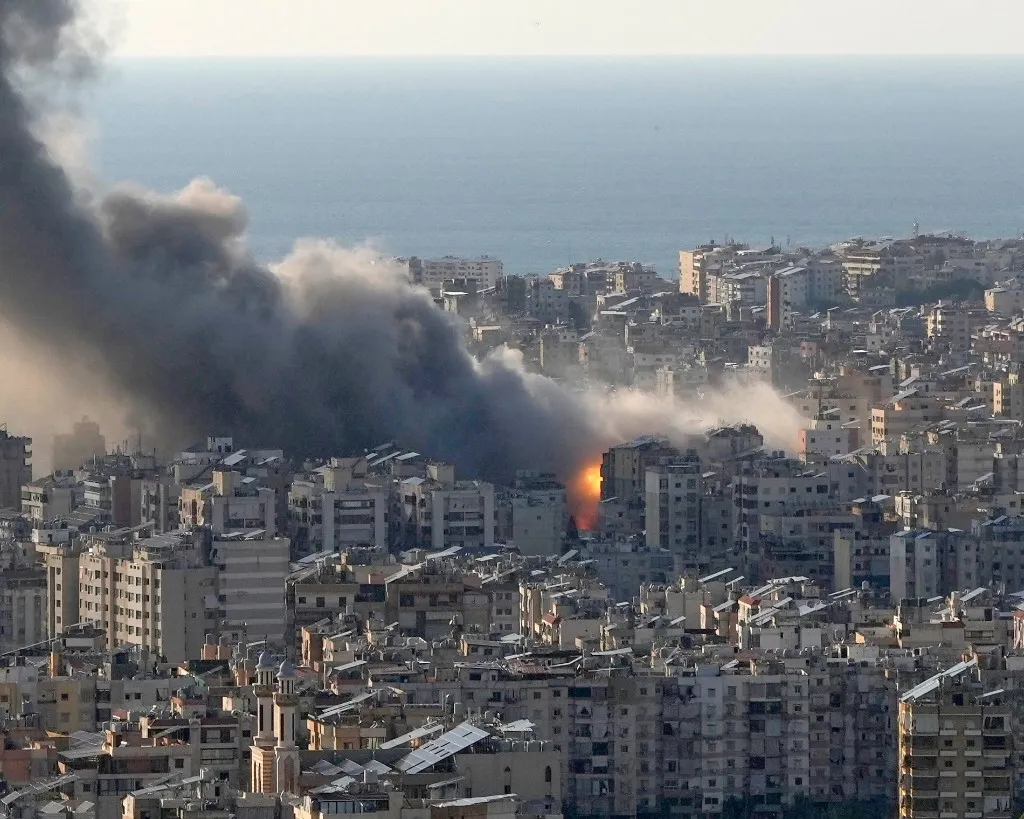
Over the past two decades, something subtle but profound has been happening in the history of war.
Wars are ending less often with grand campaigns or sweeping territorial conquest.
Increasingly, they conclude with the physical removal of a single critical individual.
At the same time, two different models of conflict have been unfolding in parallel. One resembles traditional industrial-age warfare — armored divisions, territorial lines, attrition. The other looks entirely different: precise, intelligence-driven, node-focused.
I do not study warfare professionally. My work focuses on how AI reshapes organizations. But it is impossible to ignore how similar structural shifts are now transforming conflict.
When organizational forms change, warfare changes with them.
And once the efficiency gap becomes clear, the shift is irreversible.
From a purely operational standpoint, the performance difference between these two paradigms is staggering.
What follows is not a moral argument about right or wrong. It is an attempt to describe a transformation in the structure of power.
From “Destroying Systems” to “Deleting Nodes”
Modern military operations increasingly follow a pattern:
Persistent surveillance → continuous modeling → anomaly detection → instantaneous strike.
If you examine the evolution of high-value targeting over the past several decades, you can trace a clear technological curve.
Earlier wars struggled to locate and eliminate leadership with reliability. Success often depended on luck or brute force.
Later phases relied on expansive human intelligence networks, interrogations, and prolonged physical tracking.
Then came signal intelligence, drone reconnaissance, and air-ground coordination.
More recently, multi-source data fusion and real-time targeting systems began to close the loop between detection and action.
What has changed is not simply precision.
It is ontology.
War is shifting from physically dismantling entire systems to identifying and removing key nodes within a network.
Once a sufficiently detailed graph exists, action becomes recursive. Targets can be prioritized top-down by network centrality and dependency weight — provided information coverage is deep enough.
The structural logic behind this shift is simple: dependence inversion.
Any organization that relies on digital coordination and communication becomes more efficient. But that same coordination produces dense informational signatures around decision hubs.
The more central the node, the brighter it glows in the data.
AI Begins to See the Battlefield
In 2017, the U.S. Department of Defense launched Project Maven. Its public goal was straightforward: use machine learning to analyze vast amounts of full-motion video from drones and satellites.
At the time, it appeared to be a logistical efficiency upgrade.
In reality, it marked something deeper.
For the first time in history, a battlefield was being persistently and proactively perceived by machines.
Algorithms began to automate:
- Continuous personnel and vehicle recognition
- Long-term pattern-of-life modeling
- Subtle anomaly detection across environmental signals
War entered a new phase. Humans were no longer simply watching screens. Algorithms were continuously computing the world.
When large models are integrated into these systems, the distinction between sensing and cognition begins to collapse. Perception and decision modeling converge.
The Neural Network of War
If distributed sensors are the eyes, global low-latency connectivity is the nervous system.
Satellite constellations have demonstrated that robust communication infrastructure no longer depends entirely on vulnerable ground-based stations.
Low-earth-orbit networks provide:
- High bandwidth
- Minimal latency
- Persistent global coverage
This is more than a communications upgrade.
For the first time, the battlefield resembles a real-time planetary neural network. Sensors are no longer isolated assets. They are components in a continuously connected computational fabric.
War shifts from a geographically bounded activity to a layer within a real-time global system.
The Emergence of a Central Cognitive System
Combine these components and a larger structure appears:
Global multi-dimensional sensing → real-time data transmission → AI pattern analysis → centralized fusion → automated option generation
Modern joint command architectures aim precisely at this integration across air, land, sea, space, and cyber domains.
The war machine begins to resemble a brain.
A general may authorize a strike. But the options presented, probabilities calculated, and targets highlighted are increasingly generated by systems processing volumes of data no human could synthesize in real time.
Human-in-the-loop remains the formal doctrine.
But the human role is already changing.
AI Inside the Decision Chain
Recent debates about AI companies revising policies around military use point to a deeper transformation.
The core issue is not text generation.
It is that AI systems are moving into real operational decision chains.
When AI participates in:
- Multi-source intelligence analysis
- Probability and risk modeling
- Tactical option generation and resource matching
It ceases to be “software.”
It becomes part of the cognitive architecture of command itself.
Four System Principles of Modern Warfare
1. Intelligence First
Strike windows can shrink to minutes.
Human reaction speed alone is insufficient. Data must enter algorithms before it reaches humans. Machines model the world first; humans validate.
2. Everything Becomes Data
Gait patterns, electromagnetic emissions, vehicle trajectories, thermal signatures — all become measurable variables.
The battlefield becomes a computational space.
What cannot be digitized becomes operationally invisible.
3. Real-Time Feedback
Traditional OODA loops compress into near-continuous cycles:
Detect → verify → act → assess → update.
Systems begin to learn while fighting. Optimization occurs mid-conflict.
4. Centralized Cognition
All fragments of information must converge somewhere.
This “center” is not merely political authority. It is cognitive integration — the place where disparate data streams assemble into coherent situational awareness.
Without synthesis, fragments remain noise.
Decapitation as Mathematical Outcome
Once such systems mature, a cold logic from graph theory becomes visible.
In any network, nodes with the highest centrality — those upon which others depend most — are statistically easiest to identify.
In traditional hierarchical organizations, concentrated authority generates:
- High communication density
- Abnormal protective clustering
- Extreme centrality in network topology
High-value targets illuminate themselves within sufficiently rich data graphs.
Targeting leadership becomes less a matter of search and more a matter of computation.
The Gap That Decides Wars
In this environment, decisive advantage no longer lies solely in the number of carriers, tanks, or troops.
It lies in information velocity and algorithmic superiority.
The asymmetry is stark.
If one side operates within a global real-time system capable of continuous modeling and prediction, while the other cannot even detect that it is being observed, the conflict may be structurally decided before kinetic action begins.
Technological generation gaps become strategic cliffs.
Recursion and the Mirror of Organizations
As sensors expand and models improve, a recursive cycle forms:
More data → stronger models → more precise action → richer new data
Systems feed themselves.
Faced with such architectures, the safest organizational form may resemble a swarm: decentralized, distributed, lacking a single irreplaceable core.
Remove one node, and the system persists.
Yet there is tension.
Centralization enhances intelligence efficiency.
Decentralization enhances survivability.
The conflict between these principles defines the strategic design problem of the AI era.
Conclusion
Digitization makes reality visible.
Global connectivity makes reality continuous.
AI makes reality computable.
When these three forces converge, traditional hierarchical structures reveal inherent fragility.
Centers of power become optimal targets within algorithmic systems.
Future wars may look less like armies colliding in trenches and more like silent computational systems identifying and removing critical nodes within vast data networks.
And if more advanced forms of artificial intelligence emerge, this trajectory will not slow.
It will accelerate — toward the physical limits of computation and control.