All of human civilization has always followed the same underlying structure: ideas are abundant, but execution is what creates value. For most of history, the ability to get things done determined who won and who didn’t.
Everyone knows what kinds of activities are considered useful—working out, learning a foreign language, reading, building products, starting projects. And everyone also knows this: wanting to do something is rarely the bottleneck. The real constraint has always been execution.
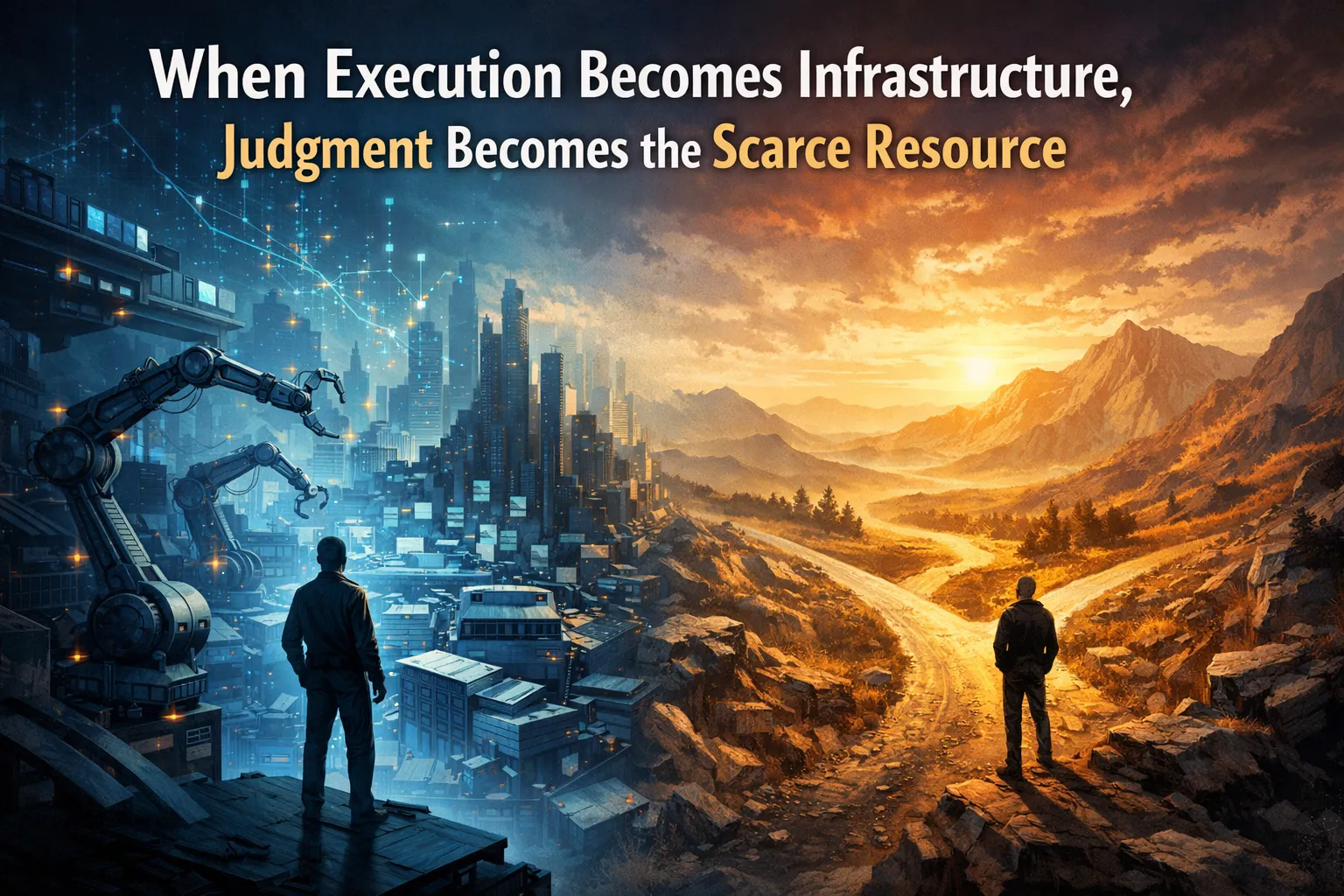
Companies are built around execution. Management exists to keep execution from going off track. Salaries exist to make people willing to execute. Education exists to give people the ability to execute. Venture capital invests in execution as well. You have an idea, I have an idea—who gets the money? The one who can make it real.
After Agents, a single person with a single weekend can build what previously required an entire team working for half a year. Everyone now has nearly unlimited execution power. We have entered the age of spectacle.
At this moment, “getting things done” has shifted from being a scarce resource to basic infrastructure. And once that happens, we are forced to rethink the question of value: what, exactly, is still worth something?
Because the old ruler can no longer measure new things.
“I have an idea, I just need a programmer”
This sentence has been mocked countless times in startup circles.
In the past, that mockery was justified. An idea by itself was worth nothing, because between idea and product lay a massive execution gap. You needed to hire people, form teams, write code, test, launch, and iterate. Ninety-nine percent of ideas died at the execution stage. That’s why investors evaluated founders the same way every time: execution first, execution second.
But now, this sentence is turning into a real business model.
The founder of OpenClaw built a weekend project alone. A single architectural judgment triggered thousands of plugins and an entire industry chain. Three months later, it was absorbed by OpenAI.
In the past, “work ability” was a blended product. Judgment and execution were permanently tied together—sold together, evaluated together. A good doctor both diagnoses and treats; you can’t easily separate the value of their judgment from the value of their hands. A good engineer both designs systems and writes code; you can’t clearly tell whether their value comes from architecture or implementation.
Agents separate these two.
Once execution is taken over, judgment is exposed. Each person’s judgment stands alone and is tested directly by the market.
When execution becomes abundant, judgment becomes the only scarce resource.
Our education systems, corporate structures, and career paths were all designed to cultivate execution. Universities spend four years teaching people how to do things, but not a single course teaches how to decide what is worth doing. Promotion systems reward people who “get things done,” not people who “choose the right things.” From entrance exams to performance reviews, society measures execution efficiency.
But in an era where Agents can execute almost everything for you, the abilities selected by this system are precisely the ones most easily replaced.
The way judgment is used is also changing. In the past, execution was expensive. Verifying a judgment took months or even years, so you had to think everything through before acting—being wrong was costly. Now, an Agent can ship a minimum version in days. Results speak for themselves. Judgment no longer needs to be perfect before you act.
Before, the rule was: think clearly, then act.
Now, it is: act in order to think clearly.
There is a side effect worth paying attention to. Judgment has always been forged through friction—through making mistakes, hitting walls, and feeling resistance firsthand. These experiences are the soil in which judgment grows. Agents compress this process.
At the same time, AI makes trial and error far cheaper, expanding the training ground for judgment. Whether this ultimately turns out to be good or bad is unclear. But it is worth every manager asking themselves one question: does your team still have enough opportunities to hit walls with their own hands?
Judgment gains compounding power for the first time
Once judgment is separated, it gains a property it never had before: it can operate independently of the person who made it.
When a good architectural judgment is encoded into a system, it can be executed and amplified continuously by thousands of Agent instances. The person who made the judgment can leave, but the judgment keeps running. This is exactly what happened with OpenClaw’s “Agents that bootstrap plugins.” The founder moved on to OpenAI, but the judgment had already been encoded into the ecosystem, where thousands of plugins continue to grow.
For the first time, judgment can generate value independently and continuously.
In the past, only institutions could do this. Laws, accounting standards, documentation norms—all of them are encoded judgments that continue operating after their creators are gone. But institutions update on the scale of decades. In the Agent era, the cycle from judgment to encoding to large-scale compounding can be measured in days.
Some might argue that the stock market is already a market for judgment. That’s true, but it is second-order judgment: you are judging whether others are competent, not directly steering reality yourself.
What emerges in the Agent era is a market for first-order judgment. Your judgment turns directly into reality. No company, no team, no execution layer is required in between. One person’s architectural judgment can equal an entire industry chain.
Judgment becomes a directly tradable asset.
That is why every good judgment you make should be encoded into systems. A judgment written into meeting notes can only influence the people in the room. A judgment written into an Agent workflow can continue operating and compounding even when you are no longer present.
This is also why AI projects feel “expensive.” Traditional valuation looks at assets, revenue, and profit. But in an era where judgment compounds, a large portion of a project’s value comes from the quality of judgments already encoded into its systems—and from how much those judgments are compounding. None of this appears on financial statements.
When the excuse of “can’t be done” disappears
“Can’t be done” has always helped us make decisions.
For thousands of years, human motivation was built on the gap between desire and ability. We wanted to fly but couldn’t. We wanted to cure diseases but couldn’t. We wanted to turn ideas into products but lacked money, people, or time. Differences in execution limits formed a natural filter. Many choices never required conscious rejection—“can’t be done” eliminated them for us.
When execution costs approach zero, this filter breaks.
Write a book? An Agent can draft it in a day.
Build a product? Launch it over a weekend.
Test a new market? Run several Agents in parallel and get results in two days.
All the choices previously excused by “can’t be done” come rushing back.
In the past, saying “I want to learn painting, but I don’t have time” protected you. It spared you from a sharper question: do you actually want to paint? Now that all conditions are available, many people discover that they don’t—or, more painfully, that they don’t know what they want at all.
When the excuse of “can’t be done” is removed, every “not doing” becomes an active choice.
At the company level, this logic is even more destructive. Strategy meetings used to rely on a universal shield: “resources are limited, we need to focus.” When execution resources are no longer scarce, “focus” shifts from an objective constraint to a subjective judgment. Choosing not to do A now requires explaining why A is not worth doing—you can no longer say “we don’t have the bandwidth.”
This era rewards explorers
In 1831, Faraday discovered electromagnetic induction. A magnet passing through a coil produced current. At the time, the discovery had no practical use. When asked what it was good for, Faraday replied: “What is a newborn baby good for?”
One hundred and fifty years later, all of human civilization runs on electricity.
Edison’s era was no different. When electric lights first appeared, most people thought oil lamps were good enough. When the phonograph appeared, no one foresaw the recording industry. At the moment an invention is introduced, no one knows how powerful it is, what industries it will create, or what kind of future it will bring. In retrospect, these inventions became the foundations of our everyday reality.
The key difference between that era and ours lies in the cycle from judgment to validation. Faraday’s discovery took more than half a century to become an industry. Edison’s inventions took decades to spread. Great insights required long execution cycles before their correctness could be confirmed.
In our era, Agents compress this cycle to the extreme. You form an insight, make a judgment, and let Agents run. Within days, results arrive. Results tell you whether the judgment was right and how to adjust. You adjust, then let Agents run again.
Insight is the starting point. Agents are execution. This is how one becomes a modern inventor.
The faster this loop runs, the sooner you reach the correct answer. Faraday needed decades per iteration. We may need only days. In the same amount of time, you can run dozens of iterations. Each iteration sharpens insight and improves judgment.
This is why the age of spectacle rewards explorers. Agents reduce the cost of validating exploration to near zero. In the past, mistakes were too expensive, so you had to think everything through before acting. Now mistakes are cheap, but not acting becomes increasingly costly, because the window is narrowing.
Ecological positions are more valuable than spectacle itself
The biggest trap of the age of spectacle is believing that creating spectacle is enough.
Once execution costs collapse to the individual level, spectacle can be mass-produced. Smartphone photography provides a completed reference case. When the cost of taking photos dropped to zero, billions of photos were produced every day. Most were worthless. What remained valuable was the eye behind the camera: when to shoot, what to aim at, and when to press the button.
History offers a parallel. After Gutenberg invented the printing press in the 15th century, the cost of copying collapsed and books flooded the world. Most became worthless. The real question became which books should be printed. Publishers—a previously nonexistent role—became the most critical actors of the era. They did not copy or write; they judged what was worth amplifying.
Every collapse in execution costs follows the same pattern: a brief gold rush where everyone profits, followed by mass extinction, and finally the establishment of a new order. The internet took roughly fifteen years to complete this cycle. The Agent era may complete it in two or three.
Those who survive are the ones who establish new order amid chaos.
Agent-generated creations evolve on their own. You set the initial conditions, but you do not control how they grow. Agents can analyze other Agents’ plugins and write better versions themselves. Spectacles will consume one another.
Only ecological positions endure. If you disappear and many things break, you have a position. If you disappear and almost nothing changes, you don’t. These positions are rarely glamorous. They exist at the base: protocols, data layers, standards, default configurations.
What is valuable is not just creating spectacle, but occupying the positions others depend on after spectacle fades.
As for policy, traditional industrial policy supports specific products and companies. In the age of spectacle, the spectacle you support may be replaced within three months. A more effective approach may be to support the density of judgment—to allow high concentrations of judgment to collide continuously. In the past, we encouraged inventors. Now, we encourage explorers.
Old business logic is evaporating
Returning to the opening question: why can’t old rulers measure new things?
Over the past twenty years, the internet economy has tied the physical world to human attention. Search engines sell attention during search. Social platforms sell attention in feeds. E-commerce sells attention during shopping. We assumed information flows between people, demand originates from people, and attention belongs to people. The basic unit of economic activity was the human individual.
In the human era, markets had to be cultivated. Creating a new category required educating users, shaping culture, and building habits over years. Short video platforms took years to cultivate viewing habits. Discount e-commerce took years to cultivate lower-tier markets.
Agent economics behaves differently. Agents have no attention; they have token budgets. They do not need education, persuasion, or cultural shifts.
More radically, an Agent can consume tokens, produce economically valuable outputs, validate them, iterate, and generate value without any human involvement. It can produce, test, iterate, and generate value on its own.
In the Agent world, good products can close the loop by themselves. No marketing teams. No growth strategies. No need to persuade individuals one by one.
As the human-centered order evaporates, new evaluation anchors begin to emerge. One is the quality of judgments encoded into the ecosystem and the magnitude of their compounding effects. The other is ecological coupling: how many Agents and workflows depend on the system, and how much breaks if it disappears.
Old anchors are dissolving. New anchors are still forming.
Those who move faster reach the correct answer first
All of the above converges on a single operating logic.
Insight is scarce. Seeing what others cannot is not cultivated by education systems and not rewarded by corporate structures, but in the age of spectacle, it is the starting point of everything.
Once you have insight, make judgments quickly. Do not wait until every detail is resolved. Let Agents run a minimum version and let results speak. If it works, increase investment and encode the judgment into systems so it compounds. If it doesn’t, adjust the insight and run again.
The faster this loop runs, the sooner you reach the correct answer. Validation used to take months. Now it may take days. In the same time window, someone who runs ten iterations gains a fundamentally different quality of insight than someone who runs only one. The former already knows which paths do not work; the latter is still debating whether to start.
Timing is difficult because the window between “too early” and “too late” is extremely narrow. That is precisely why Agents should be used to compress iteration cycles. The faster you move, the more clearly you can sense where the window lies.
In Faraday’s era, a discovery needed 150 years to reveal its full power. In Edison’s era, an invention needed decades. In our era, a judgment can become a global operating standard in a matter of weeks.
Acceleration continues. Old orders are evaporating. New orders are not yet complete. We stand between them.
No one knows what the final structure will look like. After every collapse in execution costs, humanity needed time to rebuild order: more than a century after printing, fifteen years after the internet. The Agent era may be faster, but until it stabilizes, everyone is moving through fog.
Perhaps there is only one thing we can do: maintain judgment, and keep moving forward.