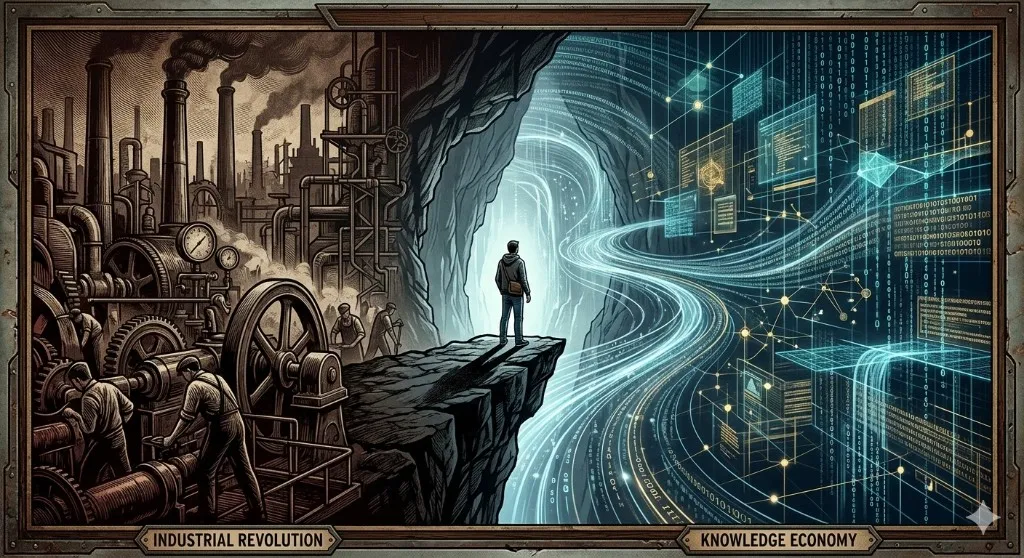
The most dangerous mistake knowledge workers can make today is not “not knowing how to use AI.”
It’s believing they still have twenty years to adapt.
They don’t.
We may be the first generation in history forced to watch our core professional abilities overtaken by machines — in the middle of our own careers.
It wasn’t like this before.
The steam engine replaced muscle.
The loom replaced hands.
Cars replaced legs.
For two hundred years, physical labor was automated.
Cognitive labor remained safe. Machines could be powerful, but they didn’t think.
That assumption broke in 2023.
By 2026, the consequences are becoming impossible to ignore.
Those at the frontier are already burning tokens aggressively, leveraging 10x or 50x productivity gains to pull ahead.
Most people still haven’t processed what this means.
The holidays are a good time to think it through.
Acceleration Is the Real Variable
Consider adoption timelines.
Electricity took 46 years to reach 50% of American households.
The telephone took 35 years.
Television 22.
The internet 7.
Smartphones under 5.
ChatGPT reached 100 million users in two months.
The point isn’t that “AI is popular.”
The point is that the adaptation window for each technological wave is shrinking exponentially.
During the Industrial Revolution, a textile worker had a generational buffer.
He might be displaced, but his son could retrain.
When automobiles replaced horse carriages, carriage makers were wiped out — but society had roughly twenty years to adjust.
AI may not offer twenty years.
It may offer less than five.
Most AI Discussions Stay on the Surface
Most conversations about AI revolve around listing what it can do:
Write code.
Generate video.
Create images.
Translate.
Produce slides.
Handle customer support.
All true. All superficial.
Imagine discussing cars in 1900 and saying, “It can move people. It can move goods. It’s faster than a horse.”
Correct — but missing the real transformation: urban design, suburbanization, oil geopolitics, traffic law, teenage culture.
In 1964, Marshall McLuhan articulated a framework that still feels uncannily relevant today. In Understanding Media, he wrote:
“The medium is the message.”
He expanded on this idea:
“The personal and social consequences of any medium — that is, of any extension of ourselves — result from the new scale that is introduced into our affairs by each extension of ourselves, or by any new technology.”
To make the point concrete, he used the electric light:
“The electric light is pure information. It is a medium without a message, as it were… This fact merely underlines the point that ’the medium is the message’ because it is the medium that shapes and controls the scale and form of human association and action.”
A lightbulb carries no narrative. It delivers no content.
Yet it created nightlife, shift work, illuminated factories, and a 24-hour economy.
It rewrote society’s relationship to time.
Seen through that lens, AI should not be analyzed primarily by what it produces.
The real question is:
What scale does it change?
What pace does it accelerate?
What patterns of association does it reorganize?
At least three structural shifts are already visible.
1. The Scarcity of Expertise Is Collapsing
Legal advice required a lawyer.
Medical diagnosis required a specialist.
Architectural planning required a consultant.
Information asymmetry meant pricing power.
AI turns “80-percent professional knowledge” into something close to a public utility.
This isn’t incremental efficiency.
It destabilizes the economic foundation of knowledge scarcity.
A rough analogy: when cloud computing commoditized infrastructure, traditional data center pricing collapsed.
Once the base layer becomes standardized, intermediaries built on asymmetry become vulnerable.
2. The Boundary Between Creation and Consumption Is Blurring
If you use AI to write code, are you a developer or a product manager?
If AI drafts the design and you refine it, are you a designer or an art director?
This isn’t wordplay.
When job definitions shift, skill valuation shifts.
When skill valuation shifts, education systems eventually follow — though usually an order of magnitude slower than technology itself.
3. Thinking Is Being Externalized
Previously, writing meant drafting internally before committing words to paper.
Increasingly, people begin with half-formed ideas, feed them to AI, iterate in dialogue, and co-produce the final output.
Your prompt becomes a trace log of your reasoning.
Not just code, but thought processes become reviewable.
Not just modules, but mental templates become reusable.
Not just results, but the path to conclusions becomes auditable.
This is not just productivity gain.
It changes how cognition itself is structured.
Four Historical Patterns
1. The Middle Tier Suffers Most
The printing press didn’t harm illiterate peasants — they weren’t using manuscripts.
It harmed scribes.
Cars didn’t eliminate horses entirely.
They eliminated carriage craftsmen who had spent decades mastering their trade.
Search engines didn’t hurt people who never used libraries.
They hurt encyclopedia salesmen and reference desk staff.
Technological revolutions don’t primarily displace those far from the system.
They displace those whose skills sit directly within the substitution zone.
AI’s impact on translators, junior developers, copywriters, legal associates, and accountants follows the same logic.
2. Society Adapts Generationally, Not Individually
It wasn’t carriage drivers who became automobile pioneers.
It was a new generation raised in a car-native world.
It wasn’t newspaper journalists who dominated blogging.
It was people who never entered a newsroom.
Every technological shift produces a sacrificial window.
Not because those individuals failed —
but because their skill maturation overlapped with technological replacement.
Knowledge workers between 35 and 50 should examine whether they fall into this window.
3. Second-Order Effects Matter More Than First-Order Effects
The first-order effect of printing was cheaper books.
The second-order effect was the Reformation and the rise of nation-states.
The first-order effect of telephones was easier communication.
The second-order effect was the permanent blurring of work and personal life.
The first-order effect of search engines was faster information retrieval.
The second-order effect was redefining intelligence itself — memory devalued, question-asking appreciated.
AI’s first-order effect is faster work.
The second-order effects are unknown.
History suggests they will dwarf the first-order changes — and likely emerge in areas we aren’t currently discussing.
4. Institutions Lag Technology by at Least a Generation
The printing press emerged in the 1440s.
Publishing norms stabilized in the 17th century — after 150 years of upheaval.
Cars spread in the early 1900s.
Traffic laws matured in the 1930s.
The internet exploded in the 1990s.
Comprehensive data regulation didn’t arrive until decades later.
If this pattern holds, AI governance may not stabilize until the 2040s.
That leaves a 15–20 year institutional vacuum.
Historically, such periods resemble the Wild West.
Rules are undefined.
Early movers shape them.
For individuals, that’s both risk and opportunity.
A Practical Timeline
Search engine adoption unfolded in three phases:
2000–2005:
Not knowing how to search was inconvenient, but survivable.
2005–2010:
Poor search skills began to reduce work performance.
“Google it” became everyday language.
2010–present:
Not knowing how to search is almost equivalent to functional illiteracy.
AI appears to be following a similar curve — faster.
2023–2025:
Avoiding AI mainly reduces efficiency. Work can still be done manually.
2026–2030:
Avoiding AI starts to erode core competitiveness.
The productivity gap between AI-assisted engineers and non-AI engineers could reach 10–100x.
2030 and beyond:
Society assumes AI collaboration ability by default — just as it assumes search literacy today.
We are currently in the transition between phase one and phase two.
This is the most comfortable stage.
It is also the largest preparation window.
Once phase two is fully underway, differentiation will already be entrenched.
Catching up will become far more expensive.