For the past few years, most conversations about AI products have centered on the model.
Which model is better.
Which benchmark is higher.
Which company has the next breakthrough.
But as more AI products reach real users, a different question has come into focus:
What actually drives value in AI products may have less to do with model strength and more to do with the environment the product lives in.
OpenClaw is a clear example. Its underlying capabilities are comparable to other agent tools, yet it quickly gained attention and discussion in user communities. That forces a sharper question:
What has to be true for an AI product to create real value?
Break it down and three conditions have to hold:
- Context: The AI understands what the user is doing.
- Delivery: The AI’s output can turn directly into outcomes (not just text to copy elsewhere).
- Collaboration: The human and the AI settle into a stable way of working together.
When these three happen naturally, the AI is operating inside an effective environment.
The Real Competition: Environment, Not Raw Capability
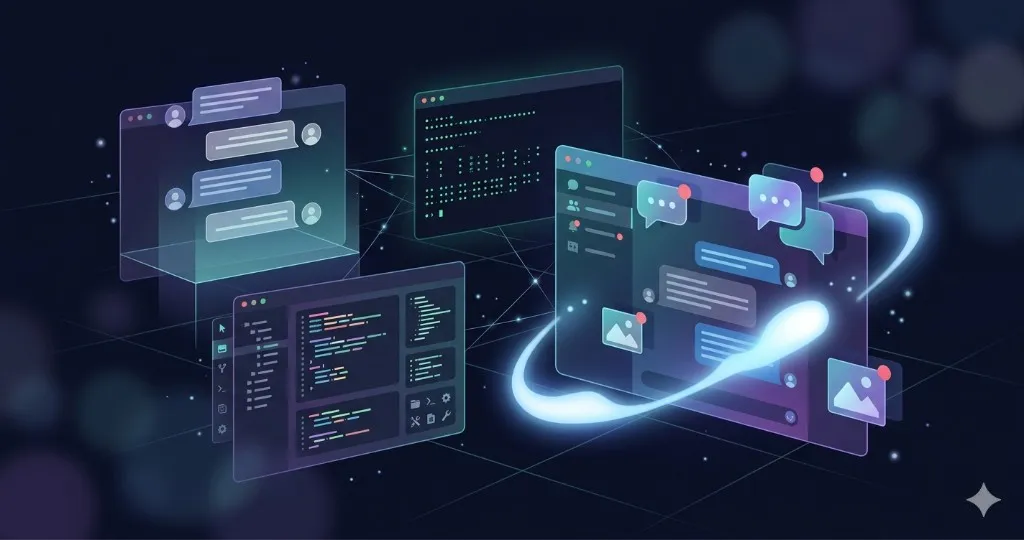
In AI product discussions, the focus is often on the surface: chat windows, IDE plugins, terminal tools. Those are containers, not the full environment.
A real environment has two layers.
The first is the container: where the user meets the AI. Examples:
- ChatGPT’s web chat
- Cursor inside the IDE
- Claude Code in the terminal
- OpenClaw in IM (e.g. Telegram, Discord)
The second is the space where the AI can sense and act:
- Cursor can read the whole repo
- Claude Code can use the file system and shell
- OpenClaw can reach email, calendar, files, and other services
Only when the container is connected to that space do those three conditions appear: context flows in, the AI can finish tasks directly, and human–AI collaboration can persist.
Without that second layer, the AI is just a Q&A widget. ChatGPT is the obvious case: you paste context in and copy results out. The AI never enters your real workspace.
Cursor and Claude Code go further because they act on the codebase. OpenClaw pushes further still: it aims at your whole personal operating environment (mail, calendar, files, IM, and whatever you plug in).
Models matter.
But environments determine whether those models actually become products.
Why OpenClaw Took Off
On paper, OpenClaw isn’t more capable than other agent tools. Claude Code can also read and write files, run commands, call APIs, and automate tasks. The difference is the container: OpenClaw lives in instant messaging (IM).
That choice changes three things.
Friction drops. People already use IM all day. No new UI to learn, no extra app to open. Send a message and the AI is there. The cost of starting an interaction is minimal.
Work becomes asynchronous. In an IDE or terminal you often wait for the AI to finish. In IM you send an instruction and leave. The AI runs in the background and pings you when it’s done. That feels more like working with a colleague than driving a tool.
The AI can initiate. IM is built for notifications. So the AI isn’t only answering; it can push updates: email replies, schedule conflicts, task completion, system changes. Once the AI can start the conversation, the relationship shifts from “using a tool” to “working with an agent.”
Same Capability, Different Environment, Different Use
The same underlying AI can be used in very different ways depending on where it lives.
In a terminal, typical requests look like: refactor this, run that script, deploy, debug. They’re technically scoped. In IM, requests look like: reschedule the meeting, reply to this email, capture this idea, handle this errand. They’re life and work management. The AI can do both kinds of tasks; what changes is what people ask for.
So:
The environment shapes what users think to ask.
Competition among AI products is therefore not only a race on model quality. It’s also a race on which environment you choose to inhabit.
What Users Are Actually Doing With OpenClaw
To see how OpenClaw is used in practice, I looked at over 2,000 Reddit posts. Roughly 1,300 described concrete use cases, which I grouped into 16 categories.
The standout: the most discussed topic was how to run and secure the system, not which app to build. Top of the list was local and private deployment (around 18%). After that came: coding and building apps (17%), personal assistant use (12%), security and hardening (10%), and business automation (9%). The rest spread across DevOps, monitoring, smart home, trading, creative work, education, and more. Plenty of variety, no single dominant use.
That suggests something important: OpenClaw behaves less like an app and more like a base layer. People are probing new uses instead of converging on one fixed scenario.
Where AI Product Design Is Heading
OpenClaw points to a shift in how AI products are built.
Older tools assumed the user comes to the AI: open a chat, type a question, get an answer. Newer products invert that: the AI comes into the user’s world. The AI is no longer a destination you visit; it’s something that’s always there.
That inversion suggests three directions.
AI will sit closer to real environments. Soon it won’t only touch documents or code. It will touch file systems, calendars, comms, devices, and external services. It will act as part of your digital environment rather than a separate app.
Collaboration will be more asynchronous. You won’t have to watch the AI work. More flows will look like: you give an instruction, the AI runs it, results show up. Closer to how you work with another person.
AI products will behave more like platforms. As skill systems and plugin ecosystems grow, the product is less “one tool” and more “a system that can be extended.” New behavior can come from users and third-party developers, not only the core team. Over time these products may look more like automation platforms and OS-like infrastructure than point solutions.
Closing Thought
OpenClaw’s rise is less about one hit product and more about a shift in what an AI product is.
Early on, people treated AI as a smarter search bar or chatbot. As the tech improves, AI is moving into users’ real environments. When it can understand context, complete tasks directly, and collaborate over time, it stops being a tool and starts being a way of working.
The real contest may no longer be about who builds the best model.
It may be who gets their AI into the user’s core environment.