
Inside AI labs, researchers believe the most explosive phase of progress may still be ahead.
For the past year, a common narrative has taken hold across the AI industry:
Scaling is slowing down.
Larger models are producing smaller gains. Benchmarks are improving more gradually. Some researchers have begun to argue that the explosive phase of large language models may already be behind us.
But inside the labs building these systems, the story looks very different.
At a recent Morgan Stanley Technology, Media & Telecom Conference, Anthropic CEO Dario Amodei dismissed the idea outright:
“We do not see hitting the wall.”
If anything, he suggested the opposite. The most dramatic phase of AI progress may still lie ahead — and it could arrive sooner than most people expect.
If almost anyone else made that claim, it might sound like hype.
But Anthropic sits at the center of the current race to build more capable AI systems. Its Claude models power a growing number of enterprise applications, and the company is widely considered one of the three or four organizations operating at the frontier of AI development.
When someone in that position says the curve is still climbing, it’s worth paying attention.
The Wheat and Chessboard Problem
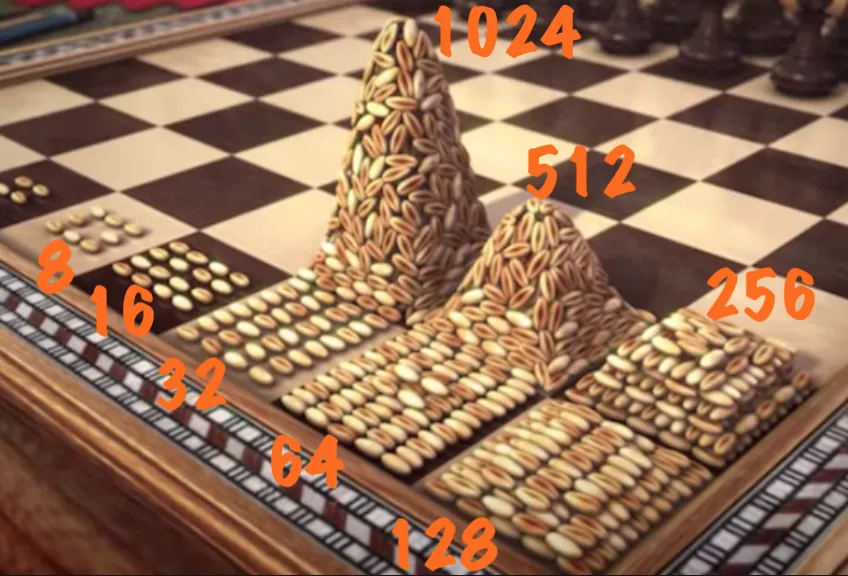
To explain why AI progress might suddenly appear to accelerate, Amodei referenced a classic illustration of exponential growth: the Wheat and Chessboard Problem.
The setup is simple.
Imagine a chessboard with 64 squares. Place one grain of wheat on the first square, two on the second, four on the third, doubling the amount each time.
At first the numbers seem trivial.
But by the final square, the total reaches roughly:
18,446,744,073,709,551,615 grains of wheat.
That figure is so large that even if the entire world devoted its wheat production to the task for thousands of years, it would still fall short.
The real lesson of the puzzle isn’t the final number.
It’s how misleading the early stages are.
The first half of the chessboard looks manageable. The first 32 squares together add up to roughly four billion grains — a large quantity, but still imaginable.
Yet those 32 squares represent only a tiny fraction of the total.
The real explosion happens in the second half.
By the time you reach the mid-30s, each new square adds more wheat than all the previous squares combined.
This is how exponential curves behave.
They look slow — until they suddenly don’t.
According to Amodei, AI development may currently sit somewhere around the fortieth square.
If that estimate is close to reality, then much of what we’ve seen so far — from GPT-3 to ChatGPT to today’s frontier models — may still represent the early portion of the curve.
The steepest part could still be ahead.
Why 2026 Could Look Very Different
During the conference, Amodei described the coming period with two words:
radical acceleration.
Not steady improvement.
Acceleration.
The trajectory of the past few years already hints at this shift.
In early 2024, most people used AI primarily for small tasks: summarizing documents, drafting emails, or generating quick pieces of content.
By the end of that year, AI coding assistants had become embedded in many developers’ daily workflows.
By 2025, attention shifted toward AI agents capable of executing multi-step tasks across multiple tools.
By 2026, systems are beginning to coordinate increasingly complex workflows.
Even so, what the public sees often lags behind what researchers see internally.
That gap has always existed in technology. But with AI, the difference may be unusually large. By the time one generation of models becomes widely available, researchers are already working on the next.
Coding as the Earliest Signal
One area where AI progress is particularly visible is software development.
Amodei described coding as one of the clearest early indicators of how quickly AI capability is improving.
Anthropic itself provides a revealing example.
The company now relies heavily on its own models throughout its internal engineering workflow. If those internal tools were billed at standard API prices, Anthropic might effectively rank among its own largest customers.
But the shift isn’t just faster code generation.
The scope of what AI systems can handle is expanding.
A useful way to think about the transformation is in stages.
Stage one: AI assists developers by generating code and suggesting fixes.
Stage two: AI begins managing parts of the surrounding infrastructure — configuring servers, analyzing logs, coordinating development tools.
At this stage, the system understands not just the code itself, but the environment in which the code runs.
Stage three: AI starts producing tools that make development itself more efficient.
In other words, the system begins contributing to the process that improves it.
According to Anthropic, this shift has already increased engineering productivity internally by roughly two to three times.
If that pattern spreads beyond software, coding may simply be the first industry to experience it.
Recursive Self-Improvement
Another concept receiving increasing attention inside AI research is recursive self-improvement.
The idea is straightforward.
Instead of humans doing all the work of improving AI systems, the systems themselves begin participating in that process.
Imagine a student who doesn’t just solve assigned problems.
The student also creates new exercises, evaluates their own answers, identifies weaknesses, and adjusts their learning strategy.
Each learning cycle improves the student’s ability to learn.
Recursive self-improvement applies the same principle to AI.
Amodei suggested that early versions of this dynamic may already be emerging. When models start generating tools or workflows that make development faster, they are effectively feeding back into the improvement loop.
If that loop becomes robust, the trajectory of progress could change significantly.
The curve would no longer reflect simple scaling.
It would begin to scale itself.
Why the “Scaling Wall” Narrative Persists
If AI progress is still accelerating, why does the opposite narrative remain so common?
Part of the answer lies in perception.
Exponential curves rarely look dramatic in the middle. Individual steps may appear modest even while the underlying numbers grow rapidly.
Another factor is that scaling no longer depends solely on model size.
Recent advances come from multiple directions at once:
- improved training techniques
- inference-time computation
- better data curation
- tighter integration with external tools
- improved system design
Progress is happening along several dimensions simultaneously.
From the outside, the curve may appear to flatten.
From inside the labs, the data still points upward.
The Implication of Exponential AI
If Amodei is right, the next few years could bring one of the most consequential technological accelerations in decades.
Entire industries may reorganize around increasingly capable AI systems. Productivity gains could extend far beyond software.
But exponential change has a consistent pattern.
It almost always moves faster than people expect.
And this time the technology accelerating isn’t transportation, energy, or communication.
It’s intelligence.
If AI development really sits somewhere around the fortieth square of the chessboard, then everything we’ve seen so far may represent only the early portion of the curve.
The second half has not yet begun.