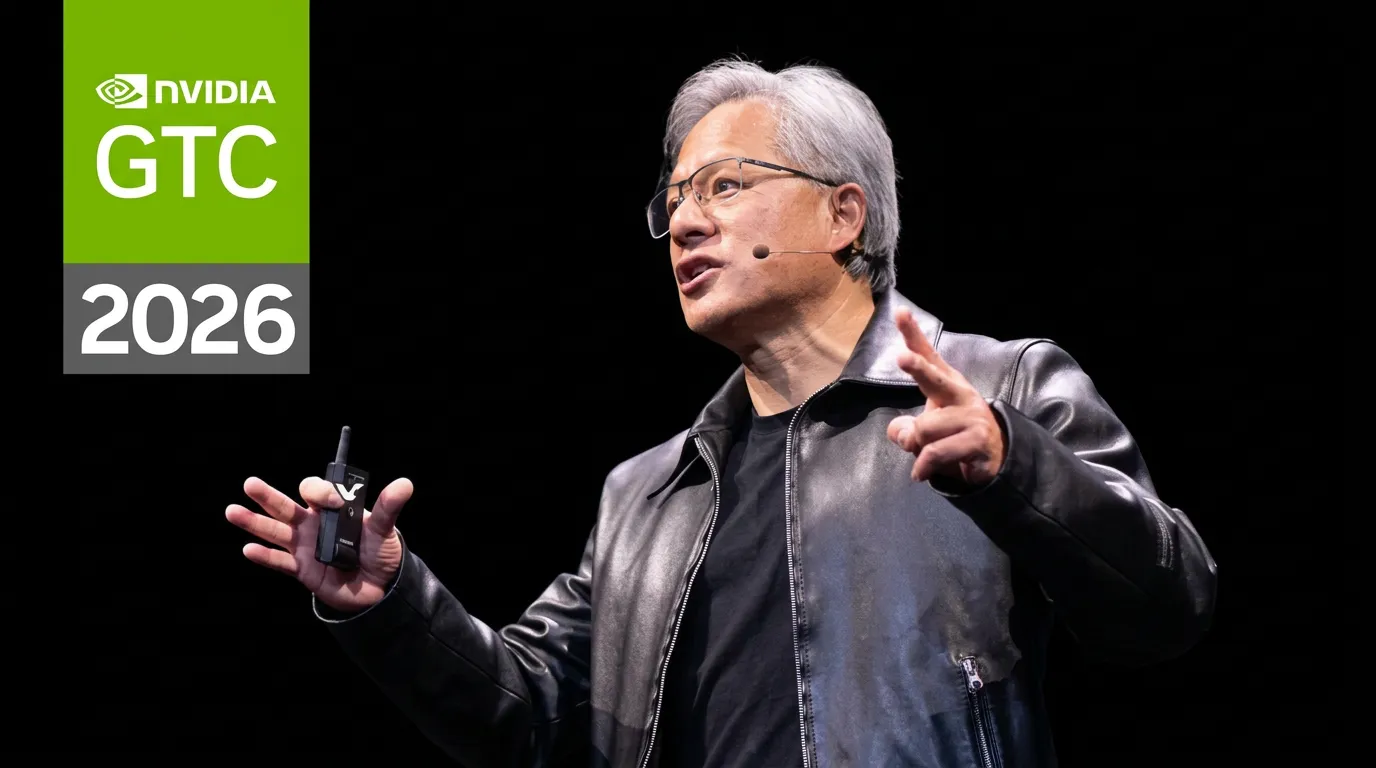
Most people came to GTC 2026 expecting new GPUs.
What they got instead was something much bigger:
AI is no longer being presented as software.
It is being redefined as infrastructure.
This shift shows up everywhere: from NVIDIA’s “AI factory” framing to the rise of agent-based systems like OpenClaw.
If you still think of AI as a tool or a feature, you are looking at the wrong layer. What’s being built now is a new kind of computing system, not software.
AI Factories Are Not a Metaphor
NVIDIA’s idea of “AI factories” is easy to misunderstand. It sounds like a bigger data center, but that framing misses the point.
A traditional data center stores and processes data. An AI factory produces something else entirely:
intelligence, in the form of tokens, decisions, and actions.
In other words:
- Input: data
- Output: tokens
- System: large-scale coordinated compute
AI factories produce intelligence the way factories produce goods. This is a structural shift.
Data centers used to be part of IT. AI factories start to look more like industrial systems.
The Trillion-Dollar Framing
Jensen Huang repeatedly referenced trillion-dollar scale — not as ambition, but as classification.
Electric grids are trillion-dollar systems. Cloud infrastructure reached that scale. Now AI is being framed the same way.
When an industry starts using “trillion” as a unit, it is no longer just a technology sector — it becomes infrastructure.
This is a deliberate narrative shift. If you think of AI as software, you will underestimate it. If you think of it as infrastructure, you begin to see its real scale.
The Stack Is Closing
What GTC 2026 actually reveals is a full stack taking shape — not loosely connected layers, but something closer to a cohesive system.
Hardware: Scale as a Barrier
With systems like NVLink 72 and next-generation architectures, compute is no longer just improving — it is consolidating.
You are no longer buying GPUs. You are entering a system.
Scaling laws still hold, but the ability to participate in that scaling is becoming increasingly constrained.
Systems: The Data Center as a Product
The shift at the system level is subtle but important.
In the past, cloud providers sold infrastructure. Now NVIDIA is packaging the data center itself as a unified product — compute, interconnect, and software bundled together.
This looks less like selling chips, and more like productizing the data center.
Software: Agents as the Default Interface
At the software layer, the interface is changing.
OpenClaw and similar systems are not just new tools. They represent a shift in how users interact with computation:
- UI → agent
- API → agent
- application → system
Agents are not just another layer. They are becoming the entry point to all layers.
The Missing Layer: Agent OS
Earlier this year, I wrote about what I called the “Operating System Moment” of AI agents — the idea that the future of agents would be shaped less by models, and more by system design.
GTC 2026 suggests something more:
the infrastructure for that moment is now being built.
If AI factories define how intelligence is produced, then something else has to define how it is executed and controlled. That missing piece is beginning to take shape as an operating system layer.
In that framing, an agent system starts to look familiar:
- models as compute
- context as memory
- storage as disk
What has been missing is coordination (process control, isolation, scheduling): the things traditional operating systems provide.
Today’s agents still resemble early computing environments: powerful, but fragile. Limited isolation, inconsistent execution, and minimal control make them work more like prototypes than stable systems.
Platforms like OpenClaw are not just better tooling; they are an early attempt to define this missing layer.
Agent is not a feature. It is a new computational unit.
From Files to Tokens
Underneath all of this is another shift.
Traditional IT systems revolve around files: databases, data lakes, spreadsheets. Everything ultimately resolves to stored data.
AI systems invert this model.
The primary output is no longer files. It is tokens.
This changes how infrastructure is organized:
- storage becomes secondary
- generation becomes primary
- compute becomes the bottleneck
Data centers used to store information. AI factories produce it.
The Most Underrated Layer: Physical AI
One part of the keynote was easy to dismiss: robotics demos. That would be a mistake.
What we are seeing is the extension of AI into the physical world, where the loop is finally closing:
- Perception
- Reasoning
- Action
When AI can act, it stops being a tool and starts becoming a form of labor.
This is where the implications move beyond software entirely.
Who Gets Rewritten?
The more interesting question is not what NVIDIA is building, but what this stack does to everything else.
Cloud: Still Necessary, Less Central
Cloud providers are not going away, but their role may shift — from core infrastructure to distribution layer.
AI factories can exist in multiple forms: hyperscale, enterprise, sovereign. Cloud becomes one option among several, not the default center of gravity.
SaaS: Compression, Not Enhancement
There is a common belief that AI will enhance SaaS. A more likely outcome is compression.
Features can be generated. Workflows can be executed by agents. Interfaces become optional.
The value of SaaS shifts from software to data, context, and domain constraints.
Where the Opportunities Are
Three layers stand out:
Agent layer — orchestration, memory, evaluation.
Crowded, but unavoidable.
Infrastructure edge — deployment, cost optimization, hybrid systems.
Less visible, but more durable.
Physical AI — robotics and simulation.
Slow-moving, but inevitable.
A New Lens
GTC 2026 did not introduce a single defining product. It did something more important:
it defined a new category.
AI is becoming an industry (AI infrastructure), not just a capability.
If the last missing piece is the Agent OS, the trajectory becomes clearer. AI factories define production. Agent OS defines execution.
This is the first time AI begins to resemble a complete computing system.
Closing
The last time computing went through a transition like this, it created entire industries.
This time may not be different.
If you still think of AI as a tool, you are looking at the wrong abstraction layer. The real shift is what AI is becoming, not just what it can do.
I explored the idea of Agent OS in more detail in “The Operating System Moment of AI Agents.”