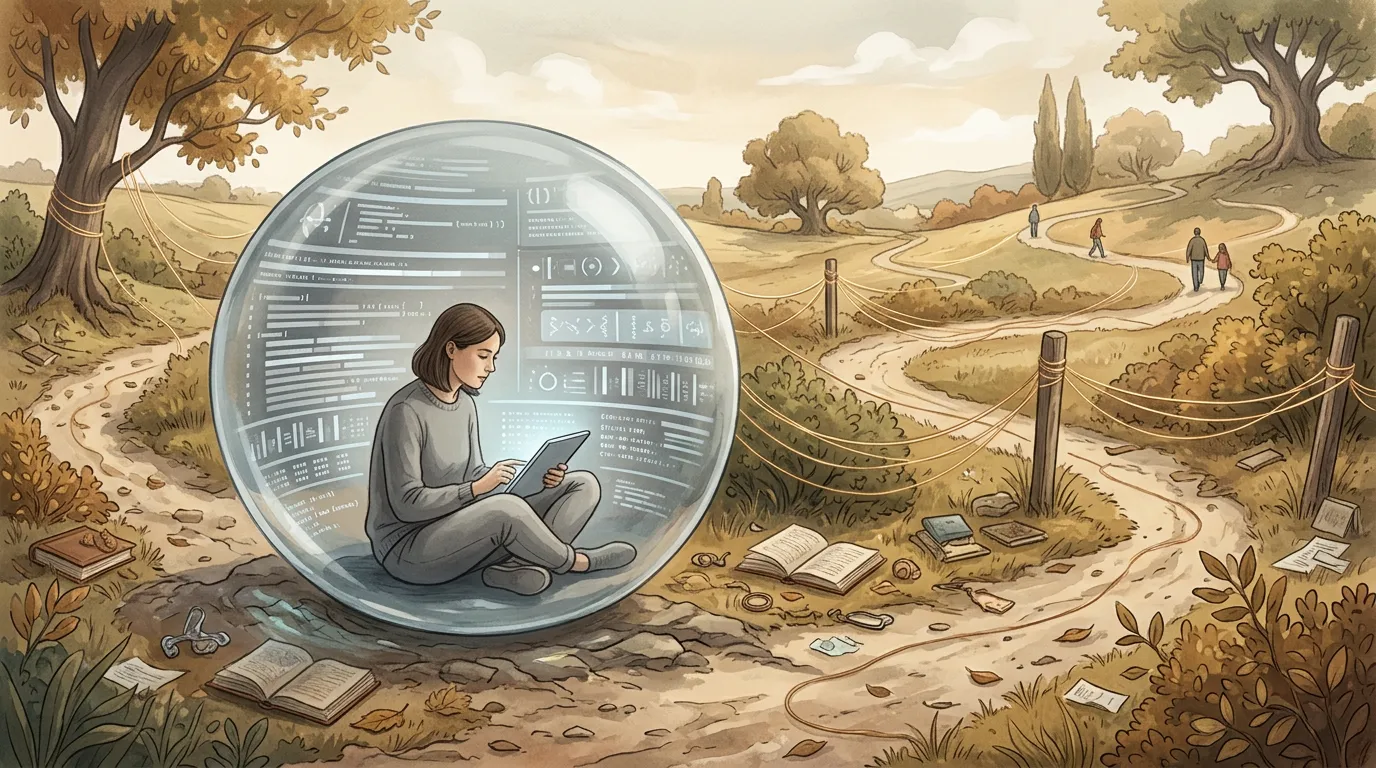
A friend recently showed me his new tool, beaming with excitement.
He follows about 5,000 people on X. Researchers, founders, investors, developers, media figures — after years of accumulating, his feed had long since become a bottomless waterfall. He’d tried “read later” apps before, bookmarking over a thousand articles and actually reading five. Like most people.
Now he uses an AI agent that reads the full output of all 5,000 accounts, compressing everything into 20 curated highlights per day. Fifty-four structured briefings in ten days. What used to take two hours to skim now takes five minutes. Ninety-five percent of noise, filtered out.
“The root of information anxiety is the cost of filtering,” he said. “Hand the filtering to an agent, and the anxiety disappears.”
He’s right. But only about the first half.
The anxiety does disappear. What also disappears is everything you didn’t know you needed to know. Five thousand tweets compressed to twenty. Among the 4,980 discarded, there might have been one from a field you’ve never followed, using logic you’ve never encountered, explaining a problem you thought you’d already figured out.
You’ll never see it. Because your agent decided for you: not relevant.
Marshall McLuhan wrote a line in Understanding Media: The Extensions of Man that has been quoted countless times: media are extensions of man. (For a fuller application of McLuhan’s toolkit to AI, see AI Through a McLuhan Lens.) But most people selectively ignore what follows:
“Every extension of mankind, especially technological extensions, have the effect of amputating or modifying some other extension.”
The AI agent extends your information-processing capacity. What it amputates is your capacity for serendipity — the ability to stumble upon an unexpected idea, to be struck by information entirely outside your field of vision, to have your cognitive framework forcibly reorganized.
The filter bubble was built by algorithms on your behalf. This time, you built it with your own hands.
AI Filtering Is a New Kind of Amputation
In 2011, Eli Pariser ran an experiment that has now been almost forgotten. He had two friends search for “Egypt” on Google — same search engine, same moment. The results were completely different. One saw pyramids and travel information; the other saw crowds in Tahrir Square and protests.
He called this phenomenon the “filter bubble” and wrote it into a book: The Filter Bubble: What the Internet Is Hiding from You. Pariser is an American internet activist and former executive director of the progressive organization MoveOn.org.
The villain was the algorithm — platforms quietly deciding behind the scenes what was worth seeing and what wasn’t. The book was published eleven years before ChatGPT was born.
The situation hasn’t improved. It has simply gotten worse in a different way. The echo chamber is no longer secretly built for you by platforms; it’s something you’ve personally commissioned your AI agent to construct. You signed the delegation papers, and you still think it’s a productivity miracle.
This is a story about efficiency, but not with the ending you’d expect.
Return to McLuhan’s amputation principle. The AI agent can digest a hundred newsletters in three seconds, distill the content you “really need to follow” from your timeline, compress originals into summaries you can comfortably read. It is genuinely an efficiency tool. But what is it amputating?
Not time. Not attention. What it amputates is cognitive wandering.
Weak Ties, Serendipity, and the Death of the Cyberflâneur
In 1973, sociologist Mark Granovetter published a paper titled “The Strength of Weak Ties.” He studied hundreds of people’s job-search processes and arrived at a counterintuitive conclusion: the information that actually brings opportunities almost never comes from your closest friends and colleagues. It comes from old classmates you haven’t spoken to in years, distant relatives you rarely see, strangers whose business cards you exchanged at a conference and never contacted again.
The reason is this: your closest relationships overlap heavily with your own information. You consume similar content, know similar people, hold similar judgments about the world. These are strong ties, but strong ties contain no new information. Truly unfamiliar information can only come from weak ties — from people you barely know.
The optimization logic of the AI agent is to continually reinforce strong ties. It knows you better and better, pushes “content you’re interested in” with increasing precision, and presents fewer and fewer things that diverge from your taste. In this logic, weak ties are noise — impurities to be filtered out.
But that noise is the only place where cognitive wandering exists.
In 2012, technology critic Evgeny Morozov wrote an essay titled “The Death of the Cyberflâneur.” He borrowed Walter Benjamin’s figure of the flâneur: the person who wanders aimlessly through nineteenth-century Parisian streets, turning corners at random, gazing into shop windows, observing crowds, discovering the world in unexpected places. Benjamin saw this wandering as the most important spiritual state of modern urban culture — it keeps people open to the unexpected.
Morozov argued that the early internet had this spirit of wandering. You drifted through hyperlinks, without purpose, without expectation. One article led to another, one name led to a piece of history, and you never knew where you’d land.
That kind of wanderer has almost ceased to exist. The AI agent is the ultimate tour guide: it has planned the optimal route, it knows your destination, it ensures you never get lost. But precisely because of this, you can only ever arrive at places you already knew you wanted to go.
This Isn’t a New Problem, but This Time It’s Different
The feeling that “there’s too much information to read” isn’t an anxiety our generation invented.
In 1545, Swiss naturalist Conrad Gessner published Bibliotheca Universalis, attempting to compile a catalog of all known books at the time. In the preface, he complained of the “confusing and harmful multitude of books.” This was roughly a hundred years after Gutenberg invented movable type.
In 1685, French scholar Adrien Baillet warned outright that the ever-growing number of books would “plunge future centuries into barbarism.”
Francis Bacon’s famous line was spoken in this context:
“Some books are to be tasted, others to be swallowed, and some few to be chewed and digested.”
Every generation facing an information flood invents new shortcuts. Indexes, abstracts, scrapbooks, anthologies, commonplace books.
Harvard professor Ann Blair studied how scholars from the sixteenth to eighteenth centuries managed information and found an ironic cycle: anxiety over the surplus of books spawned more books to help you “read less,” and those books themselves worsened the surplus. She wrote about this in Too Much to Know: Managing Scholarly Information before the Modern Age.
From this angle, the AI agent is just the latest generation of reading shortcut. Nothing new.
But this time there is one fundamental difference.
Every information-filtering tool of the past — indexes, abstracts, encyclopedias, editors, curators — shared one common trait: they didn’t know who you were. Bacon’s “taste/swallow/chew” taxonomy was a public standard. An encyclopedia presented the same entries to every reader. A newspaper editor laid out the page by news value and didn’t change the headlines based on your reading history.
The agent knows who you are. Its filtering criteria are a function of your behavioral data — what you’ve read, what you’ve highlighted, how long you lingered, what you skipped. Everyone receives a different set of “highlights.” Not because the world presents a different face to each of you, but because each person’s agent has tailored the world using its owner’s cognitive model.
The information shortcuts of the past were a “public narrowing.” You and others read the same digest and might discover the same surprise within it. The agent creates a “private narrowing.” Everyone is locked in a reading room that belongs only to themselves, containing only the books they want to see.
One person’s existence happens to illustrate why this distinction matters.
Robert Cottrell, founder of The Browser newsletter. He reads 1,000 articles every day. Not scanning headlines — actually reading. Subscribed to 700 RSS feeds, having taken in between 3 and 5 million pieces over 10 years. Every day, from those 1,000, he selects five to send to his readers.
He also tried using machine learning to replace himself. He trained a model, feeding in all past selections as training data. The result: the model picked about 50 articles out of 1,000, and roughly half were false positives.
His reflection:
“The more I read the more I become persuaded that the real guarantee of quality in a piece is that the person who’s written it is great.”
Cottrell’s value isn’t that he reads a lot. An agent can read a lot too. His value is that his judgment criteria don’t derive from your behavioral data. What he recommends might confuse you, might challenge your assumptions, might come from a field you’ve never followed.
The agent does matching; Cottrell does triage. Matching makes you comfortable; triage makes you grow.
The Explore/Exploit Tradeoff: Why AI Agents Get You Stuck
In computer science, there is a classic dilemma called the explore/exploit tradeoff. Imagine you’re standing in front of a row of slot machines, and you don’t know which one has the highest probability of paying out. You can choose to “exploit” — keep pulling the one that currently feels most rewarding — or you can choose to “explore” — randomly try other machines, even if you win less in the short term.
A system that over-exploits falls into a local optimum. You find one decent machine, keep pulling it, and never discover that there’s a better one in the corner.
The AI agent’s instinct is to exploit — to continuously refine within the range of your known preferences. This makes it extremely efficient, and it also makes it increasingly difficult for you to encounter the kind of information that changes your worldview.
One story is worth mentioning here.
Richard Feynman went through a period of professional collapse at Cornell University. He was exhausted and felt that physics held no joy for him anymore. He made a decision: abandon all “important” and “promising” research directions, and purely for fun, calculate the trajectory of a spinning plate that someone had tossed into the air in the cafeteria. It had nothing to do with any frontier research, had no efficiency to speak of, no significance. It was just fun.
That plate’s wobble ultimately became the starting point for his theory of quantum electrodynamics. He won the 1965 Nobel Prize in Physics for it. (He recounted this story in Surely You’re Joking, Mr. Feynman!)
If Feynman had had a sufficiently efficient AI agent to plan his research path, it would certainly have filtered out “calculate the trajectory of a cafeteria plate,” because that was low priority, a waste of time, matching no keywords.
Smoothness Is Not Neutral — It Is a Form of Deprivation
Byung-Chul Han wrote in The Expulsion of the Other: Society, Perception and Communication Today that contemporary society is eliminating all “others” that carry negativity, heterogeneity, and resistance.
Our world is becoming ever smoother, ever more frictionless. Algorithms always push what you like; your feed no longer contains genuine dissonance, no questions that leave you at a loss, no perspectives you never imagined encountering.
The extreme of this smoothness is a cognitive vacuum.
Neuroscience has made an interesting discovery: when humans stop performing goal-directed tasks and enter a state of mind-wandering or daydreaming, a system in the brain called the Default Mode Network activates. In this state, the brain begins connecting distant, seemingly unrelated memories and concepts — this is the neurological precondition for insight and creativity.
The AI agent keeps our brains operating in task-execution mode at peak efficiency for extended periods. Information flows in continuously, processed, categorized, prioritized — efficient, tidy, with no gaps.
The gaps that would let the brain enter default mode have been eliminated. Not because you lack time, but because your information feed is so full that there are no cracks left for the brain to run aimlessly.
McLuhan wrote that the message of the electric light bulb is not what it illuminates, but the very fact that it makes night disappear. The same applies to the AI agent: its greatest impact is not how much content it processes for you, but that it fills every blank moment in your information feed. The state of idly clicking into a strange link and then sitting somewhere unexpected, thinking for a long while — that is disappearing.
Don’t Use AI’s Logic to Navigate Your Life
The world Pariser described in 2011 had one premise: you were a passive victim. Platforms were manipulating things behind the scenes; algorithms were deciding what you could see without your knowledge. You could be angry, you could switch to a more “open” platform, you could feel deceived.
Now the problem is harder to deal with, because you are complicit. You open the AI agent, let it process your information feed, let it decide what deserves your attention, let it condense 5,000 follows into a single briefing. You think you’re saving time. In reality, you’re signing a cognitive power of attorney.
You have surrendered the right to cognitive wandering. That filter knows you better and better, pleases you more and more, grows more and more precise — and the degree of its precision is exactly equal to the degree to which your world contracts.
Five thousand follows, and the ones that actually enter your consciousness each day are the handful the algorithm deems most suitable for you, further refined by AI into the most easily digestible form, and placed before you.
Among those 5,000 people, how many spinning plates are being filtered out?
The extreme of efficiency is a person sitting inside their own echo, sinking deeper and deeper, believing this is what it means to stay on top of world events.
AI is trained to find patterns and consensus. When you use it to filter information, it pulls you toward the center of mass of all users.
Emily DeJeu, a professor at Carnegie Mellon University’s Tepper School of Business, said something worth sitting with:
“Humans aren’t machines of creativity. Sometimes, we thrive at our most inefficient.”
Those seemingly time-wasting moments of accidental reading. Being drawn to a completely unrelated piece of content in your feed, following a link to a field you’ve never heard of, discovering in an article you’d never have opened a metaphor that changes the way you think. These are the off-road training sessions of your cognitive system.
The agent has paved you a straight highway. The cost is that you will never again walk those side paths overgrown with wildflowers.